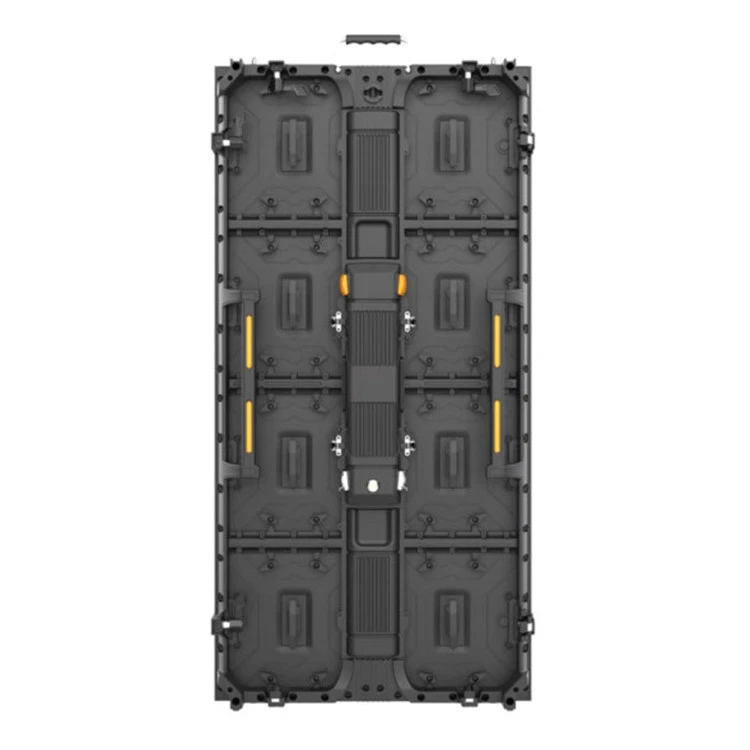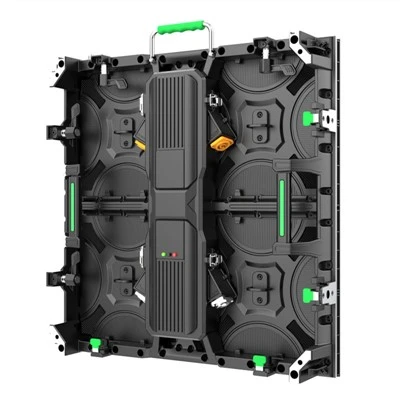

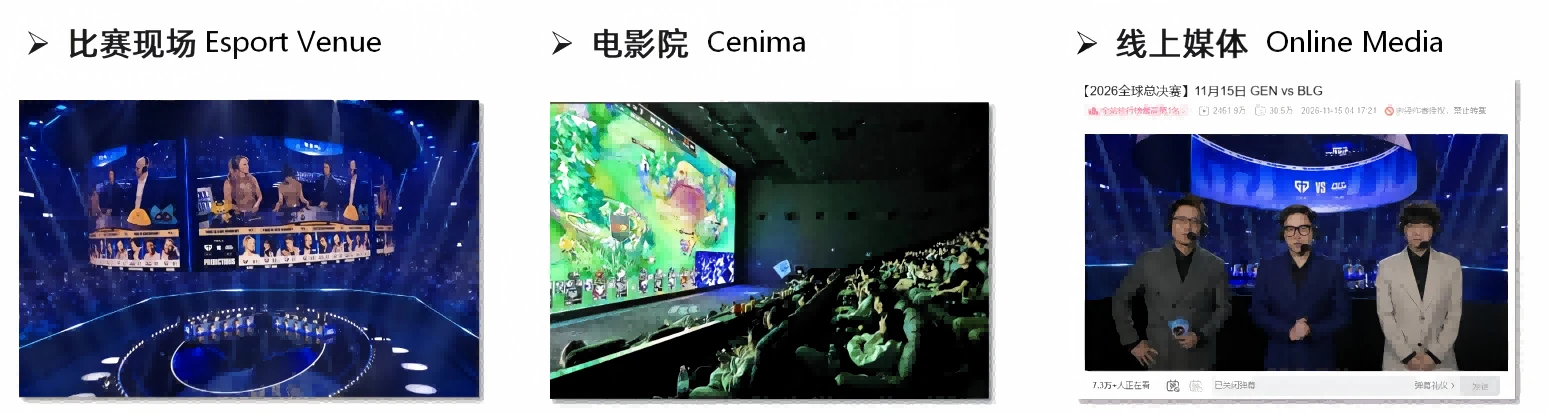
The League of Legends World Championship drew tens of millions of global viewers. Fans watched live from the arena, in cinemas, or via online streams. Across all viewing settings, LED displays serve as the core visual backbone that carries the excitement of the tournament.
Esports stage LED screens have evolved: from simple display panels, to immersive stage backdrops, and now integrated experience systems combining real-time rendering, lighting and audio. Display is no longer an auxiliary facility, but an integral part of competitive storytelling.
1. New Challenges Brought by Upgraded Demands
Esports viewing has expanded beyond the main venue. Secondary offline scenarios-cinemas, urban outdoor screens and fan zones-accommodate massive off-site audiences.
Fast-paced MOBA gameplay, with moving characters, flashy skill effects and overlay UI, imposes strict requirements on LED panels: high refresh rate, fine grayscale, precise frame synchronization and ultra-low latency. 16-bit grayscale and 7,680Hz refresh rate have become key targets.
2. Specs on Paper Do Not Equal Reliable Image Quality
16-bit grayscale delivers 65,536 gray levels for smooth visuals and clean camera capture. 7,680Hz reduces motion blur and eliminates scan lines and flicker for broadcast.
Yet most 7,680Hz products involve trade-offs. With PWM dimming, the narrowest sub-frame pulse is extremely tight at this refresh frequency. Many panels cannot sustain full 16-bit grayscale and 7,680Hz simultaneously. Refresh performance also rises with brightness; low-grayscale dark scenes are prone to flicker when filmed.
3. Can 15,360Hz Fill the Gap?
A well-designed 15,360Hz architecture offers more headroom for sub-frame scheduling. Optimized driving and algorithms reserve sufficient sub-frames for dark scenes, maintaining stable high refresh and suppressing camera flicker.
However, a higher nominal refresh rate alone brings no benefit. Without dedicated low-grayscale optimization, 15,360Hz fails to improve dark-scene shooting performance. Acceptance tests for esports LED screens must include dark-field camera validation, instead of relying only on peak-brightness parameters.
Summary
Esports LED screens have moved past the pursuit of sheer size and brightness. As content flows to live streams, cinemas and short-video clips, broadcast-friendly high-grayscale high-refresh LED is turning from a premium option into a baseline requirement. LED displays now serve not only on-site audiences, but also cameras, post-production pipelines and online viewers worldwide.